
A preschooler does not see a puzzle as a worksheet. They see a bright red fire truck that needs its wheel, a friendly animal missing its tail, or a picture waiting to become whole. That is exactly why educational puzzles for preschoolers can be such a brilliant part of everyday play: learning happens while little hands are busy, curious and proud of each small win.
The right puzzle is not about racing to finish or choosing the highest piece count. It is about giving children a satisfying challenge they can return to, gradually understand and eventually complete with a triumphant “I did it!”. For parents, grandparents and gift buyers, durability matters too. A puzzle that survives repeat play, small spills and enthusiastic handling has far more value than a one-afternoon novelty.
Why educational puzzles for preschoolers work
Preschool children learn best through direct experience. They need to touch, turn, test and try again. A jigsaw puzzle gives them all of that in one calm, screen-free activity.
As a child looks for a piece, notices its colour or matches the curve of an edge, they are practising visual discrimination. As they rotate it to find the right position, they are developing spatial awareness and early problem-solving. Picking up and placing a piece also strengthens fine motor control, which supports later tasks such as drawing, using scissors and fastening clothing.
Just as valuable is the emotional side of puzzling. Preschoolers are still learning how to cope when something does not work the first time. A well-chosen puzzle creates manageable moments of frustration followed by success. With a little encouragement, children learn persistence without the pressure of getting every answer right immediately.
Puzzles can also spark rich conversations. A farm scene prompts animal names and sounds. A world map invites questions about places. A construction vehicle puzzle can lead to a chat about what happens on a building site. The picture is not merely decoration - it gives adults an easy starting point for language-building play.
Choose the challenge, not just the age label
Age recommendations are an essential safety guide, particularly where small pieces are involved, but they are only the beginning. Two children of the same age can have very different puzzle confidence, attention spans and interests.
For a younger preschooler, simple inset-style puzzles, chunky pieces or small jigsaws with clear images are often the best fit. Look for pictures with strong colour contrast and familiar subjects such as animals, vehicles, dinosaurs, food or favourite storybook-style characters. A child who can quickly recognise what belongs in the picture is more likely to stay engaged.
Older preschoolers may be ready for more pieces, more detailed illustrations and trickier shapes. They might enjoy sorting edge pieces, finding colours in a busy scene or working alongside an adult. The sweet spot is a puzzle that needs thought but does not become so difficult that it ends in tears or gets swept into the toy box unfinished.
A useful rule is to choose a puzzle a child can mostly manage independently, with a grown-up nearby to offer a prompt rather than take over. Try saying, “Can you find another piece with blue sky?” instead of pointing to the exact answer. That keeps the discovery with the child.
What makes a preschool puzzle genuinely educational?
The strongest learning puzzles do not need flashing lights, recorded instructions or a label promising ten skills at once. They make a clear idea visible and invite children to explore it at their own pace.
Animal, alphabet, number and transport themes are popular for good reason. They support vocabulary and recognition through repetition. But picture puzzles also build broader skills when the subject feels meaningful to the child. A colourful garden scene can encourage counting flowers. A puzzle of sea creatures can introduce words such as tentacles, coral and shell. A globe-inspired design can build curiosity about the wider world long before formal geography lessons begin.
It also helps to vary puzzle types rather than expecting one puzzle to do everything. A simple matching puzzle supports recognition; a traditional jigsaw develops visual-spatial thinking; a three-dimensional build adds construction and sequence. Rotation keeps play fresh while allowing children to revisit familiar challenges and notice their own progress.
Durable materials make repeat play more rewarding
Preschool play is hands-on, which means puzzle pieces may be dropped, carried around the house, used in imaginative games or occasionally meet a snack-time spill. This is where material quality makes a noticeable difference.
Premium plastic jigsaw pieces offer a satisfying, sturdy feel and are designed to interlock firmly. Unlike flimsy cardboard pieces that can bend, split at the corners or lose their shape, durable plastic puzzles are made for repeated handling. Water-resistant designs are especially practical for family life, as they can be wiped clean after minor messes.
A firm fit matters for young children too. When pieces stay together, a child can see the picture forming and feel that their work is secure. They can carefully lift a finished puzzle, show it to a parent or leave it on display without needing glue. That creates a stronger sense of achievement than a puzzle that falls apart the moment it is moved.
There is a trade-off, of course. Premium puzzles can cost more than disposable cardboard alternatives, and very intricate interlocking pieces may not suit a child who is still developing hand strength. For preschoolers, prioritise manageable piece sizes, a clear image and an age-appropriate design over detail alone.
How to make puzzle time feel easy and fun
The setup can make as much difference as the puzzle itself. Choose a low, clear surface with good light and begin with only one puzzle at a time. A tray or puzzle mat can help keep pieces from wandering under furniture, especially in a busy family room.
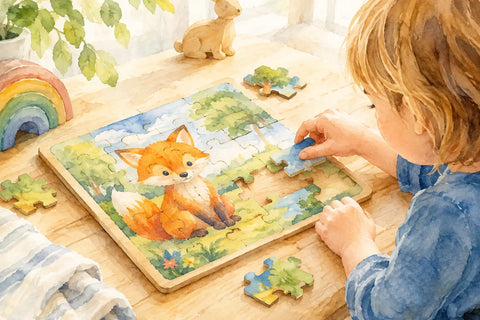
Start by looking at the finished picture together. Ask what the child can see, then invite them to find pieces from a recognisable area: perhaps the yellow sun, the green dinosaur or the wheels on a bus. Some children like to turn every piece picture-side up first; others are happy to search as they go. Both approaches are useful.
If a child is stuck, keep help light and specific. Pointing out an edge, grouping similar colours or suggesting they rotate a piece can move the puzzle forward without removing the challenge. Praise the process as much as the finished picture: “You kept trying different ways” can be more powerful than “You are so clever”.
Short sessions are completely fine. A preschooler may complete six pieces before morning tea, return for another ten later and finish the rest with a sibling after dinner. Leaving a puzzle unfinished is not failure. It teaches children that enjoyable work can happen in stages.
Puzzles that grow into keepsakes
A beautiful puzzle can be more than an activity. Once completed, it can become a proud display piece in a bedroom, playroom or family space. This is especially appealing for children who love a particular animal, vehicle, fantasy scene or colourful artwork and want to keep their finished creation visible.
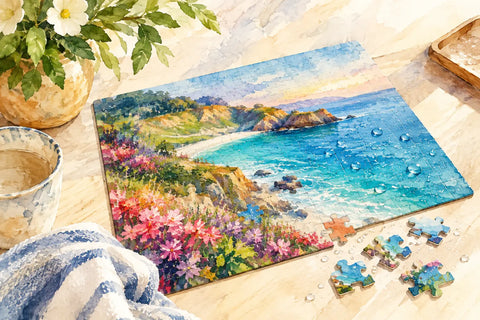
No-glue-needed plastic puzzles make that transition simple. Their secure interlocking construction means a completed design can be handled carefully, framed or showcased without turning a family project into a fiddly craft job. For gift buyers, that gives one present two lives: first as a hands-on activity, then as a piece of art a child can proudly point to.
Puzzle Art Store’s range of premium plastic puzzles is particularly suited to families who value that long-term enjoyment. The appeal is not just completing a picture once. It is choosing a design worth rebuilding, sharing and displaying.
Safety and care still come first
Always check the manufacturer’s recommended age and supervise children around any puzzle with smaller components. A puzzle intended for an older child may be beautifully made but still unsuitable for a preschooler who mouths objects or has younger siblings nearby.
Store puzzles in their box or a labelled container, and make checking for missing pieces part of the pack-up routine. For wipe-clean plastic pieces, follow the product care guidance and avoid harsh cleaners. A little care keeps colours bright, pieces clean and the next puzzle session ready to go.
The best preschool puzzle is one a child reaches for willingly: challenging enough to feel exciting, sturdy enough for everyday play and lovely enough to remain special after the final piece clicks into place.
Comments (0)
There are no comments for this article. Be the first one to leave a message!