
A new puzzle can look like glorious chaos: hundreds of tiny colours, repeated shapes and one very optimistic corner piece hiding somewhere in the pile. The quickest way to sort jigsaw pieces efficiently is not to inspect every piece in detail. It is to make a few high-value decisions first, so the image begins to reveal itself before you start building.
For serious puzzlers, families and anyone preparing a puzzle to display, sorting is the quiet work that makes the satisfying part easier. Give it a little care at the beginning and you will spend less time searching, less time second-guessing, and more time seeing the artwork take shape.
Set up a sorting space that stays useful
Start with a clean, flat surface that is bigger than the puzzle itself. A dining table works well, but a puzzle board or felt mat is even better if you need to pack up between sessions. Good lighting matters more than most people expect. Natural daylight is ideal, while a bright overhead light helps distinguish similar blues, greens and shadowy tones at night.
Keep the box lid or reference image close by, standing upright where you can see it without constantly moving it. Before sorting, turn every piece picture-side up. This is the one step worth doing thoroughly. A puzzle piece can only help when you can see its colour, pattern and potential place in the image.
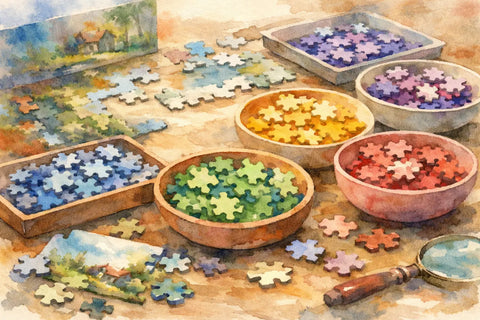
If you are working on a larger puzzle, use shallow trays, plates or small containers for your groups. You do not need a fancy system. The goal is simply to stop sorted pieces from drifting back into one large pile. For premium plastic puzzles, a smooth tray is especially handy because the firm pieces are easy to slide, pick up and re-sort without bending or fluffing at the edges.
How to sort jigsaw pieces efficiently: begin with edges
The first pass should be fast. Pull out every piece with at least one straight side and place it in a separate area. These are your border pieces, and they give the puzzle its physical limits.
Do not force the border immediately if the image is highly detailed or the frame has one solid colour. Instead, make a simple edge pile, then return to it once you have sorted the most distinctive colours and features. Building the outside first suits many puzzles, but it is not a rule. On a design with a dramatic central character, a bright flower or a recognisable landmark, starting in the middle can give you more momentum.
Corner pieces deserve their own small spot. With two straight edges, they are the easiest pieces to identify and will save you time when you are ready to complete the frame.
Sort by recognisable features, not every colour
A common mistake is making too many colour piles too soon: one for pale blue, one for medium blue, one for dark blue, then another for blue with clouds. That system can become harder to manage than the original pile.
Instead, sort into broad, useful groups based on visual features you can locate on the reference image. Think of sections such as sky, foliage, buildings, faces, lettering, water, clothing or a patterned border. A piece with a tiny red umbrella belongs in a more helpful pile than a piece labelled simply red.
For most images, four to seven groups is plenty for the first round. You can make finer divisions later when a group becomes large enough to slow you down. For example, a big foliage pile may eventually split into dark leaves, light leaves and flower petals. The right level of detail depends on the picture and piece count.
Give standout details their own tray
Anything with a clear visual identity should be separated early. Look for text, eyes, windows, stripes, jewellery, outlines, sharp architectural edges, strong colour blocks and unusual textures. These are the parts most likely to connect quickly.
A small group of pieces containing a bicycle wheel, a bold yellow sign or the edge of a vase can be more valuable than a huge pile of similar background colours. Completing these distinctive mini-sections gives you reliable anchor points, making the more difficult areas easier to approach later.
Use piece shape as a second filter
Once your colour and feature groups are in place, shape becomes a powerful sorting tool. Look at the tabs and blanks, often called knobs and holes. Within one colour group, place similar shapes together: pieces with two tabs, pieces with three tabs, pieces with tabs on opposite sides, or pieces with a distinctive narrow profile.
There is no need to create a complicated catalogue for every shape. Use it when the image gives you little to work with. A pale sky, a dark ocean or a large area of one colour can feel impossible until you reduce the candidates by both shade and shape.
This is where quality piece fit makes a real difference. Well-made plastic puzzle pieces click together securely, so you can test a likely match with confidence rather than relying on a loose fit that only looks right. If the connection feels forced, it probably is. Put the piece aside and keep looking.
Build small sections before joining the whole picture
Rather than searching the entire table for each new piece, choose one sorted group and work within it. Build a small section: perhaps a cluster of blooms, a roofline, a character's face or a brightly coloured object. Then move that completed section to the main puzzle area.
This method keeps the task pleasingly focused. It also protects your progress when you are puzzling in short sessions. A completed section is a visible win, even if you only have twenty minutes before dinner or the school run.
For display-ready puzzles, handle finished sections carefully but do not be afraid to move them if the piece fit allows. Premium plastic designs are made to hold together neatly, which is a practical advantage when arranging larger areas or preparing the completed artwork for framing. No glue needed means the finished image can stay clean and ready to showcase.
Tackle tricky backgrounds without losing patience
Every puzzle has its stubborn patch. It might be a near-black night sky, a wash of ocean, dense greenery or hundreds of almost identical bricks. When progress slows, resist tipping those pieces back into the main pile. Make the group more specific instead.
Sort by shade first: light, middle and dark. Next, separate pieces with texture from pieces that appear smooth. In a sky section, cloud edges and tiny changes in colour are usually easier than the broadest blue areas. In foliage, look for stems, shadows, leaf veins and changes in direction. Rotate the pieces only after you have compared their printed detail to the reference image.
A short break is also a legitimate puzzle strategy. Your eyes become less accurate when you have stared at similar colours for too long. Walk away, make a cuppa, and return with fresh attention. The piece that was invisible half an hour ago often becomes obvious.
Keep the system friendly for family puzzling
When more than one person is puzzling, clear trays prevent the table from becoming a scramble. Give children a recognisable section such as bright animals, vehicles, flowers or lettering, while experienced puzzlers take on the border or tricky colour gradients. Everyone contributes without competing for the same handful of pieces.
For younger children, avoid over-sorting. Two or three broad groups are enough, and the focus should remain on matching colours and enjoying the picture. For adults and collectors, a more detailed tray system can make a high-piece-count puzzle feel wonderfully organised rather than overwhelming.
If the puzzle needs to be moved, keep each group in its own container and take a quick photo of your workspace first. That small habit makes it easy to resume exactly where you left off.
Know when sorting has done its job
Sorting is there to support the build, not become a project of its own. Once you can look at a tray and know what part of the image it belongs to, start connecting pieces. You will naturally re-sort as you go, creating smaller piles for a particular window, petal, wave or colour transition.
The best system is the one that keeps you enjoying the puzzle. Some designs reward a perfectly built border and carefully separated colours; others are more fun when you chase the most eye-catching detail first. Let the artwork lead the process.
Set aside a clear space, make your first broad groups, and give the standout pieces a head start. Soon the scattered pile will feel less like a challenge to manage and more like the beginning of an artwork worth displaying.
Comments (0)
There are no comments for this article. Be the first one to leave a message!