
You finally place the last piece, step back, and realise your puzzle is too good to pull apart. That is exactly when people start wondering how to store finished puzzles without bending corners, losing pieces, or ruining the look they worked so hard to create. The right storage method depends on one thing first - are you keeping it as art, saving it for later, or moving it somewhere safer?
How to store finished puzzles without damaging them
A finished puzzle is surprisingly vulnerable in the first few minutes after completion. One bump to the table, one curious pet, or one awkward lift from the edges can turn a neat image into a sliding mess. If you are working with traditional cardboard puzzles, you usually need extra support before moving them. If you are working with premium plastic puzzles, the process is much easier because the pieces interlock firmly and hold their shape far better.
That difference matters. Cardboard puzzles are often stored flat because they flex, absorb moisture, and separate easily. Plastic puzzles, especially display-focused styles, are built for a more durable afterlife. They are water resistant, no glue needed, and often easily framed, which makes them far more practical if your goal is to keep the finished result rather than break it up again.
If you are deciding what to do next, think in terms of three storage goals. Some puzzles are meant to be displayed on a wall or shelf. Others need short-term storage while you reorganise a room or rotate your décor. Then there are the ones you want to keep long term as part of a collection. Each option needs a slightly different approach.
Best ways to store finished puzzles for display
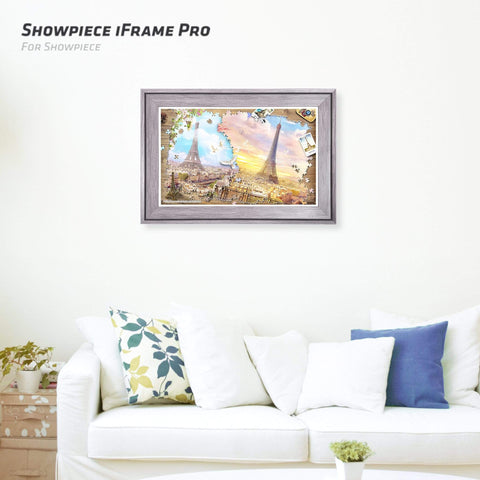
If the puzzle is worth seeing every day, storage and display can be the same thing. Framing is the cleanest option for flat 2D puzzles because it protects the surface from dust and keeps the shape secure. For cardboard puzzles, that often means using puzzle glue or adhesive sheets before framing. For high-quality plastic puzzles, framing is much simpler because the puzzle already holds together on its own.
This is where premium plastic formats really shine. A finished puzzle that stays locked together without glue is far easier to lift, position, and frame neatly. You do not have to commit to sticky products, and you are not forced into a one-shot finish. That is especially useful if you enjoy collectible designs and want your puzzle to feel more like décor than a craft project.
Shelf display is another smart choice, particularly for smaller sizes or shaped designs. A puzzle stand, plate stand, or shallow display ledge can work well if the puzzle is rigid enough to hold its form. This suits decorative scenes, mini art-style puzzles, and novelty formats that deserve to be seen rather than hidden away.
For 3D puzzle pieces such as vases, clocks, globes, or planters, storage is even more straightforward. These are not really “stored” in the usual sense - they are used, displayed, and enjoyed as functional objects. If you have finished one of these, the best storage option is often the place where it looks best and gets noticed.
Flat storage for finished puzzles
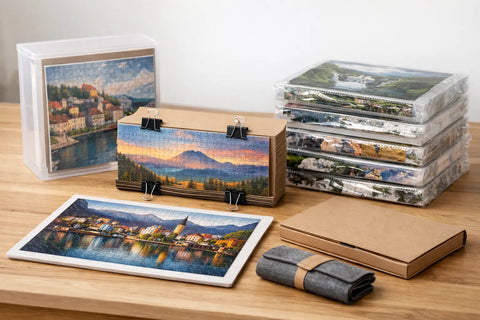
Not every completed puzzle needs to go on display straight away. Sometimes you want to keep it safe while deciding where it belongs. In that case, flat storage is usually the safest choice.
Slide the finished puzzle onto a firm backing board before moving it. Foam board, stiff card, or a puzzle mat with a solid insert can all work. The key is full support underneath, not just lifting it by the corners. Once it is on a backing board, you can place another flat board on top for protection and store it in a dry, low-traffic spot.
Avoid stacking too many finished puzzles directly on top of one another unless each one has its own rigid layer. Weight can cause warping over time, especially with cardboard. Plastic puzzles cope better, but even then, pressure and friction are not ideal if you want to preserve a clean finish.
Under-bed storage can work well if the area stays dry and dust-free. A wide, shallow storage case is often better than improvising with loose cardboard, because it protects the edges and makes the puzzle easier to move. If you are storing several completed puzzles, label them clearly so you do not keep lifting and checking every one.
Long-term storage tips that actually matter
When people ask how to store finished puzzles for the long haul, the real issue is usually environment rather than technique. Heat, moisture, dust, and pressure do more damage than most people expect.
Choose a space indoors where temperature stays fairly stable. Garages, sheds, and damp spare rooms are risky, especially in parts of New Zealand where seasonal moisture can creep into everything. Cardboard can swell or soften, and even sturdy materials can suffer if they sit in poor conditions for months.
Keep finished puzzles out of direct sun too. Bright light can fade printed designs over time, which is a shame if the image is one of the reasons you wanted to save it. If your puzzle is displayed near a window, a frame with a protective cover helps. If it is packed away, an opaque storage sleeve or case is worth using.
Dust sounds minor, but it builds fast. An uncovered finished puzzle stored on top of a wardrobe or shelf may look fine at first, then become frustratingly hard to clean without shifting pieces or scratching the surface. Covered storage is almost always the better option.
Should you glue a finished puzzle before storing it?
It depends on the puzzle type and what you want from it later. Glue makes sense if you are working with standard cardboard and want a permanent wall piece. It adds stability, but it also removes flexibility. Once glued, the puzzle becomes harder to reframe, restack, or pack without careful handling. If the glue is uneven, the finish can also look cloudy or slightly warped.
For durable plastic puzzles, glue is usually unnecessary. The main benefit of these designs is built right in - no glue needed. The pieces lock together strongly enough to make storing, framing, and displaying much more convenient. That gives you more freedom to treat the puzzle like a collectible object instead of a fragile one-off project.
If you are unsure, think about reversibility. Do you want this puzzle permanently fixed, or do you want the option to re-display it later in a different way? Glue is a commitment. Interlocking plastic construction keeps your options open.
Smart storage by puzzle type
A large flat puzzle needs different handling from a mini puzzle, and both are different again from a 3D puzzle product. That is why one-size-fits-all advice often falls short.
Large piece-count puzzles need rigid support and enough space that they are not forced into awkward angles. Smaller finished puzzles are easier to frame or store in protective sleeves. Kids’ puzzles should be stored where pieces stay together but can still be accessed easily for replay if needed. Decorative novelty puzzles are often better treated as display objects from the start.
If you collect multiple finished puzzles, it helps to organise them by size and purpose. Keep display-ready pieces separate from those you may want to disassemble later. Store seasonal or giftable designs where they are easy to retrieve without disturbing the rest of your collection. A little sorting up front saves a lot of accidental damage later.
When storage should become display
Some finished puzzles deserve better than a cupboard. If the design suits your home, framing or showcasing it usually gives you more value than hiding it away. That is especially true for premium puzzle formats made to look polished, stay together, and function as décor.
At Puzzle Art Store, that idea is central to the appeal. A premium puzzle is not just something to complete and clear off the table. It can become wall art, a shelf feature, a conversation piece, or a gift that lasts. When the materials are durable and the finish is clean, storing the puzzle often becomes as simple as deciding where you want to enjoy it most.
The best storage choice is the one that matches how you see the puzzle. If it is a memory, protect it. If it is décor, display it. And if it is both, choose a format that lets your finished puzzle keep shining long after the last piece clicks into place.

Comments (0)
There are no comments for this article. Be the first one to leave a message!