
A globe is one of those rare objects that earns its place on a shelf. It sparks travel plans, settles family geography debates and adds instant character to a study, lounge or child’s bedroom. In this plastic globe review, we look at what makes a 3D plastic globe puzzle different from a standard cardboard puzzle - and why it can be such a satisfying project for puzzlers, collectors and gift buyers.
The short version is compelling: you get the calming focus of puzzling, then a finished object you can actually display. No glue needed, no flimsy cardboard edges and no need to pack your completed work back into the box.
What is a plastic globe puzzle?
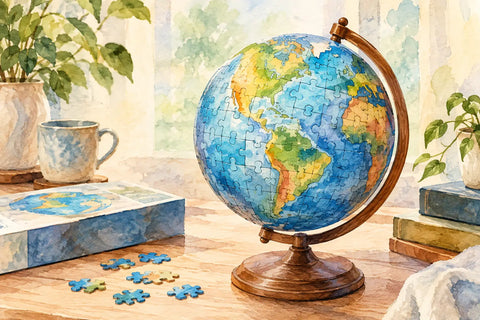
A plastic globe puzzle uses shaped, interlocking plastic pieces to build a spherical world globe. Rather than completing a flat image on a table, you assemble the world map around a rounded core or supporting structure. The result is a decorative 3D globe that stands on its own, ready for a desk, bookshelf or display cabinet.
This format changes the experience from the first few pieces. Flat jigsaws ask you to organise a border and work inward. A globe asks you to think in curves, continents, oceans and sections that gradually wrap around a sphere. It feels hands-on in a different way, with the final shape appearing as you build.
Premium plastic pieces are designed to click together firmly. That matters because a globe is meant to be handled and shown off, not carefully lifted from a dining table in the hope that it stays intact. Once assembled correctly, the pieces hold their form without glue.
Plastic globe review: the feel of the pieces
The biggest difference between plastic and cardboard is confidence. Quality plastic pieces have a firmer click and resist bending, fraying and softening at the edges. That makes assembly feel more precise, particularly on a rounded build where each connection contributes to the finished globe’s shape.
A good plastic globe puzzle should feel secure without becoming frustratingly tight. Pieces need to fit cleanly, but you should still be able to correct a misplaced piece without damaging it. This is where premium construction earns its place. The puzzle feels like a product made to keep, rather than a one-off activity destined for the recycling bin.
Water resistance is another practical advantage. It does not mean you should leave your globe outside in a downpour, but it does make everyday life less stressful. A light spill, damp hands or a dusty shelf is far less alarming than it would be with cardboard. Wipe it gently and carry on.
The finish also has real display impact. A printed world map on plastic can look crisp and polished, helping the completed globe read as décor rather than merely an unfinished craft project. For adults who want a puzzle to suit a home office, and for kids who want something cool on their desk, that distinction matters.
Is the build enjoyable or just fiddly?
It depends on what you enjoy about puzzles. If you love sorting hundreds of similar sky-blue cardboard pieces, a globe puzzle will feel refreshingly different. The challenge comes from seeing how curved sections, map details and the supporting structure work together. It rewards patience, observation and a willingness to rotate the model as you go.
For some puzzlers, the three-dimensional format has a small learning curve. You cannot spread every piece across the table and see the entire image at once in the same way. You also need enough clear workspace to turn the globe comfortably while assembling it. A dining table, large desk or puzzle board is ideal.
That said, the process is generally less intimidating than it looks. Begin by sorting pieces by colour, landmarks, continent outlines or clearly recognisable map features. Build in manageable sections and check the curve regularly rather than forcing a connection. If a piece seems wrong, it probably is.
The best part arrives near the end, when the separate fragments stop looking like fragments. Suddenly there is a recognisable world taking shape in your hands. It is a lovely moment for solo puzzlers and an even better one to share with children or visiting family.
Display value is the real upgrade
A standard puzzle can be beautiful, but it often creates a final question: what now? Framing is an excellent option, yet it requires wall space, a frame and a little planning. A plastic globe answers that question for you. Once completed, it is already a decorative object.
Place it beside travel books, on a work desk, in a reading nook or on a child’s study shelf. It works especially well in rooms that need a small focal point without adding visual clutter. The round form has presence, but it does not demand a large wall or a heavy cabinet.
This makes a globe puzzle a strong choice for renters, apartment dwellers and anyone who prefers flexible décor. Move it when you rearrange a room. Bring it out for a travel-themed party. Let guests pick it up and look for places they have visited. It is art with a conversation starter built in.
Because the interlocking pieces stay together, there is no awkward glue-and-frame stage between finishing the puzzle and enjoying it. That is a major part of the appeal. Your finished project is ready to show off straight away.
Who will enjoy a 3D plastic globe?
A plastic globe is a particularly good fit for the puzzler who already has a stack of completed cardboard puzzles but wants their next project to remain visible. It is also a thoughtful gift for travellers, teachers, geography fans, teenagers setting up a bedroom or anyone with a home office that could use more personality.
Families can enjoy it as a collaborative activity, although younger children may need help with the curved assembly and finer connections. The educational value is a welcome bonus, not a substitute for the fun. Looking for countries, oceans and familiar destinations naturally turns the completed puzzle into a reason to keep learning.
Collectors will appreciate the novelty too. A 3D globe stands apart from a collection of flat puzzle boxes, and its display-ready construction makes it easier to enjoy every day. If you are shopping for a birthday, Christmas or housewarming present, it has more impact than another generic homeware item.
A few trade-offs to consider
No honest plastic globe review should pretend that every puzzler will prefer this format. Plastic pieces usually feel different from traditional cardboard, so devotees of soft, matte, classic jigsaw pieces may need an adjustment period. The 3D build can also make it harder to casually pause halfway through unless you have a safe place to leave the project.
Map designs can be more detailed than scenic puzzles, which means the experience is less about a huge range of colours and more about careful placement. If you want a relaxed, low-concentration puzzle night, choose a piece count and design that suit your comfort level.
There is also the question of scale. Check the finished dimensions before buying. A compact globe can be perfect for a desk, while a larger one makes more of a statement but needs a more deliberate display spot. The right size depends on whether you are buying for a child’s room, a bookshelf or a prominent work space.
These are not drawbacks so much as useful expectations. A globe puzzle is best approached as a buildable décor piece, not simply a flat jigsaw in a different shape.
How to get the best result
Give yourself a clean, well-lit workspace and sort before you start. Keep the box image nearby for reference, especially when working through oceans, country borders and smaller island areas. Assemble patiently, with light pressure. Forcing pieces can lead to confusion, while a correct piece should sit naturally within the curve.
Once complete, give the globe a gentle check for any loose sections before placing it on its stand or chosen surface. A soft microfibre cloth is usually all you need for occasional dusting. Avoid abrasive cleaners, extreme heat and prolonged direct sun if you want the printed colours to stay looking their best.
For a gift, the presentation is part of the fun. Add a note suggesting a future destination, pair it with a travel book, or make the puzzle build the activity for the celebration itself. The recipient gets an experience first, then a keepsake.
A plastic globe puzzle is not trying to replace every cardboard jigsaw. It offers something more permanent: a satisfying build that ends as a piece of décor with a story behind it. For anyone who likes their hobbies to look as good as they feel, it is a clever addition to the puzzle shelf.
Comments (0)
There are no comments for this article. Be the first one to leave a message!