
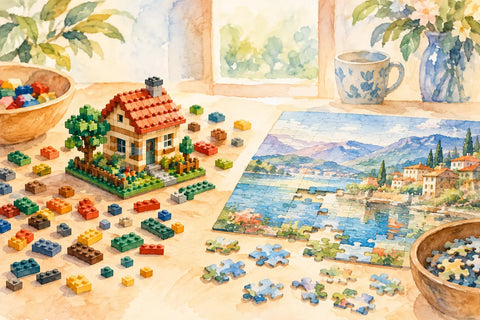
A quiet afternoon can go in two very different directions. You can sort a bright pile of tiny components and watch a miniature scene rise from the table, or you can chase that satisfying final jigsaw piece that completes a work of art. When choosing mini bricks vs jigsaw puzzles, the better pick is not simply about age or difficulty. It is about how you like to create, what you want to display, and whether the finished result should become part of your home.
Mini Bricks vs Jigsaw Puzzles: The Key Difference
Mini bricks are build-led. You follow a sequence, connect small pieces, and gradually construct an object with height, structure and character. A miniature flower shop, landmark, animal or vehicle feels like a tiny project with a clear destination. The enjoyment comes from precision and seeing a three-dimensional design take shape in your hands.
Jigsaw puzzles are image-led. You begin with a complete picture, then work towards it through colour, pattern, shape and patience. The experience is less about instructions and more about visual discovery. A cloudy patch of sky may test your persistence, while a distinctive splash of colour can suddenly solve an entire section.
Neither is automatically harder. Mini bricks tend to reward careful following of steps and steady hands. Jigsaw puzzles reward observation, sorting and a willingness to try possibilities that do not work the first time. If you enjoy building to a plan, mini bricks may feel more natural. If you enjoy getting absorbed in an image, a jigsaw is likely to be your kind of creative escape.
The Making Experience
Mini bricks suit detail lovers
The charm of mini bricks is in the scale. Small parts can create surprisingly fine details: a roofline, a tiny plant, a window frame or the curve of an animal. Each stage provides a small win, which makes brick building particularly satisfying for people who like clear progress.
There is a practical trade-off. Mini bricks demand a tidy workspace and good lighting. Because components are small, they are easier to misplace and less suited to very young children without close supervision. They can also require more hand precision than a larger-piece puzzle. For teens, adults and collectors who enjoy model-making, that precision is part of the appeal rather than a drawback.
A mini brick build often works well in shorter sessions. Complete a few stages after dinner, leave the model safely aside, then return when you have time. It is a focused, hands-on hobby that gives you a three-dimensional keepsake at the end.
Jigsaw puzzles create a different kind of calm
A jigsaw puzzle invites you to slow down. You might begin by finding the edge pieces, group colours into trays, and settle into a rhythm as the image emerges. It is wonderfully social when family or friends can gather around the table, but it is equally rewarding as a solo wind-down activity.
Piece count changes the pace. A smaller puzzle can be a satisfying weekend activity or a thoughtful gift for someone new to puzzling. Higher piece counts create a longer project with more challenge, more detail and an even bigger sense of achievement when the final piece clicks in.
Premium plastic jigsaw puzzles add another pleasure: the completed image does not need to disappear back into the box. Their firm interlocking pieces stay together without glue, so the result can be moved, framed or displayed with confidence. For anyone who has completed a beautiful cardboard puzzle only to face the messy glue-or-pack-away decision, this is a genuine upgrade.
Which One Looks Better on Display?
This is where the decision becomes personal. Mini brick creations are little sculptures. They work beautifully on a bookshelf, desk, bedside table or display cabinet, especially when the design has a playful theme or architectural detail. Their depth makes them a conversation piece, although they do need a stable spot away from accidental bumps.
Finished jigsaw puzzles are wall art. A striking landscape, floral design, illustration or abstract pattern can bring colour and personality to a room without asking for much shelf space. Plastic puzzle pieces are water resistant and designed to hold together, making them particularly practical for display. No glue needed, and no worry about a flimsy finished picture coming apart as you lift it.
If your home is short on surfaces, a framed jigsaw is often the easier choice. If you have open shelving and love miniature décor, mini bricks make a stronger statement. There is also a middle ground for people who want something more functional: three-dimensional puzzle designs such as vases, planters, clocks and globes offer a finished object with a purpose beyond display.
Durability Matters More Than You Think
Traditional cardboard puzzles can be lovely, but they are vulnerable to bent tabs, split layers and the occasional spill from a tea cup. A premium plastic jigsaw is made for repeat enjoyment and long-term display. The pieces have a polished feel, fit securely, and can handle the realities of family life more comfortably than standard cardboard.
Mini bricks are also made to last once assembled, provided the finished build is treated with care. Their individual elements are designed to connect firmly, but a knocked model can still mean a little repair work. That is not necessarily a problem. Some builders enjoy maintaining and rearranging their creations. Others prefer the solid, flat permanence of an easily framed puzzle.
For a household with children, pets or busy shared spaces, consider where the project will live while it is unfinished. A puzzle board or dedicated table protects a jigsaw in progress. A shallow tray or container keeps mini brick parts from travelling across the floor. A little organisation makes either hobby much more enjoyable.
Choosing a Gift That Will Not Feel Generic
Both options make memorable gifts because they offer an experience as well as an object. The best choice depends on the recipient.
A mini brick set is ideal for the person who enjoys tiny details, building, collectibles or desk décor. It feels like a project and a display piece in one box. Choose a theme that reflects their interests, whether that is animals, travel, architecture, plants or something delightfully quirky.
A jigsaw puzzle suits art lovers, families, mindful hobbyists and anyone who appreciates a relaxed challenge. The image is the key. Pick artwork they would genuinely want to see on their wall or in their living space once it is complete. A durable plastic puzzle adds a premium touch because it can become décor rather than a one-time activity.
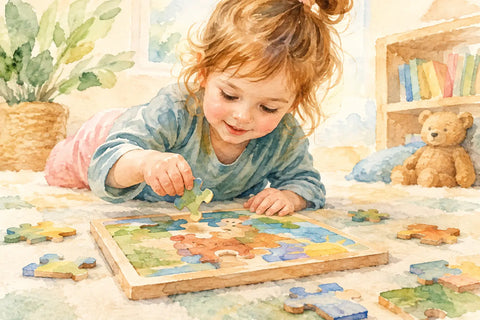
For children, match the choice to their confidence and attention span. Larger, simpler puzzle pieces help younger puzzlers build skills without frustration. Mini bricks can be brilliant for older children who enjoy following visual instructions, but the small pieces mean adult guidance is sensible for younger ages.
At Puzzle Art Store, this is why puzzles are treated as more than rainy-day entertainment. A well-chosen design can become a finished artwork, a functional object, or a collectible miniature that keeps giving long after the making is done.
So, Should You Choose Mini Bricks or a Jigsaw?
Choose mini bricks when you want to build something dimensional, enjoy precise instructions, and have a shelf ready for a small sculpture. They offer structure, detail and the pleasure of creating an object piece by piece.
Choose a jigsaw puzzle when you want to settle into an image, enjoy a flexible solo or shared activity, and like the idea of finished wall art. A premium plastic jigsaw is especially compelling when you want a result that is water resistant, easily framed and secure without glue.
Of course, the most creative households do not have to pick a side. Keep mini bricks for focused building sessions and a jigsaw on hand for slow weekends, family catch-ups or a screen-free evening. Choose the project that makes you want to clear the table, put the kettle on, and make something worth keeping.

Comments (0)
There are no comments for this article. Be the first one to leave a message!