
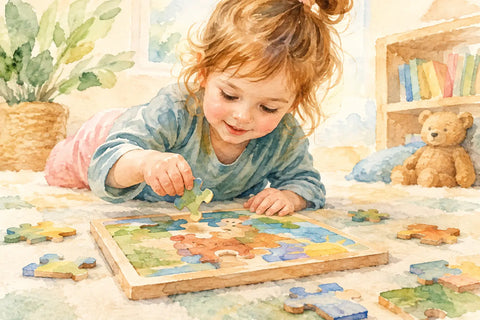
A toddler who turns a puzzle piece around three times before it finally clicks into place is doing far more than keeping busy. They are testing an idea, adjusting their grip, noticing shape and colour, and learning that patience can pay off. Toddler puzzle learning gives young children a satisfying, hands-on way to practise these small but meaningful skills, one piece at a time.
The best puzzles make this learning feel like play, not a lesson. A bright animal, a familiar vehicle or a picture they can proudly recognise gives toddlers a reason to return. When the pieces are durable, comfortable to hold and made for little hands, the puzzle can become a favourite part of the day rather than a one-off activity headed for the rubbish.
Why toddler puzzle learning works
Puzzles ask children to slow down and look closely. A toddler begins by noticing obvious clues: the red piece belongs near the red apple, the wheel probably belongs on the car, and the edge pieces feel different. With repeat play, they start making more deliberate choices. This is early problem-solving in a form that feels achievable.
The physical side matters just as much. Picking up, turning and pressing pieces into place strengthens fine motor control and hand-eye coordination. These are the same foundations children use later for drawing, using cutlery, fastening buttons and writing. There is no need to turn every play session into a skills checklist, but it is reassuring to know that a simple puzzle supports so much development.
Puzzles can also build language naturally. Sit alongside your child and name what you see: “That’s a yellow fish”, “Where could the tree go?” or “You found the last piece!” For younger toddlers, short, cheerful phrases are enough. Older toddlers may enjoy identifying colours, animals, emotions, numbers or parts of a scene.
The confidence of a finished picture
Unlike many toddler activities, a puzzle has a clear and visible ending. The picture comes together, the last piece fits, and the child can see what they achieved. That sense of completion is powerful, especially for children who are still learning to persist when something does not work straight away.
It also gives adults an easy chance to praise effort rather than speed. Try “You kept trying different ways” instead of “You’re so clever”. The first response helps children connect success with patience, observation and practice. If they lose interest halfway through, that is fine too. Toddlers learn in short bursts, and a puzzle can wait for another moment.
Choosing puzzles for toddler puzzle learning
The right challenge depends on the child, not only the age printed on the box. A toddler who loves puzzles may be ready for more pieces than expected, while another child may enjoy a simple matching puzzle for longer. Look for a puzzle that offers a few satisfying wins without being so easy that it is finished before the interest begins.
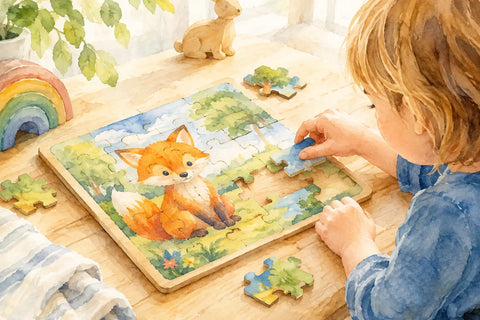
For early learners, chunky, easy-to-grip pieces and clear picture cues are usually a strong place to start. Familiar themes help children understand what they are building, whether that is farm animals, sea creatures, dinosaurs or everyday objects. As confidence grows, introduce more pieces, smaller details and scenes with a little more visual variety.
Material is worth considering as well. Toddlers explore enthusiastically, and that can include sticky fingers, a tipped drink or a puzzle carried from room to room. Premium plastic puzzles are a practical option for family life because they are water resistant, wipeable and made to handle repeat play. Their interlocking pieces stay together firmly, so a completed design is less likely to fall apart when an excited child wants to show someone.
Avoid making the piece count the only measure of progress. A child may gain more from completing the same small puzzle independently several times than from struggling through a larger one with constant help. Repetition is not boredom for toddlers. It is how they build familiarity, confidence and a sense of control.
Safety and supervision still matter
Always choose puzzles designed for your child’s age and development stage, particularly where small pieces are involved. Check pieces regularly for damage, and keep puzzles with tiny components away from younger siblings who still mouth objects. A tidy tray, low table or clear patch of floor can make the activity easier to manage and reduce the chance of pieces disappearing under the sofa.
Make puzzle time feel easy, not instructional
You do not need a special set-up or a long attention span to make puzzles part of the routine. Five quiet minutes after breakfast, a wind-down before dinner or a rainy afternoon on the dining table can be enough. Keeping one or two puzzles within reach allows your toddler to initiate play, which often leads to more engagement than being told it is puzzle time.
At first, your role may be to simplify the task. Turn pieces picture-side up, place the completed image nearby, or offer just a few pieces at once. You can point out a feature without giving away the answer: “This piece has part of the sun. Can you see another yellow bit?” Then pause. Waiting gives children room to think.
If your toddler asks for help, offer the smallest useful hint. Instead of placing the piece for them, rotate it slightly or move it near the right area. This keeps the achievement in their hands. The goal is not a perfectly independent child at every session. It is a child who feels supported enough to try.
Puzzle play can work beautifully with siblings too, as long as the expectations are fair. An older child can sort edge pieces or find matching colours, while the toddler handles the pieces that feel manageable. Choose a design that allows everyone to contribute, and celebrate the shared picture rather than who found the most pieces.
When a toddler gets frustrated
A little challenge is useful. Tears, throwing pieces or walking away repeatedly are signs the puzzle may need adjusting. The answer is not always to remove puzzles altogether. Sometimes a smaller selection of pieces, a clearer image or a fresh surface is enough to reset the experience.
Try finishing on a success where possible. If there are only two pieces left, help your toddler find one that is likely to fit and let them press it into place. Put the puzzle away while the experience is still positive. Returning tomorrow with renewed interest is far more valuable than pushing through to complete every piece.
It is also normal for toddlers to use puzzles in unexpected ways. They may line up the pieces, sort them by colour, name every animal or carry one special piece around the house. That is still exploration. Gentle redirection is useful when needed, but there is no prize for making play look exactly like the picture on the box.
From playroom activity to something worth keeping
Some puzzles are made for a brief season. Others become part of family memories: the design your child completed for the first time without help, the colourful scene they wanted to build every weekend, or the finished creation they insisted on showing visitors. Durable, display-ready puzzles give these moments a longer life.
At Puzzle Art Store, premium plastic puzzle designs bring together practical family benefits and the pleasure of a finished artwork. No glue needed, water resistance and secure interlocking pieces make them especially appealing when a completed puzzle deserves more than a quick photo before being packed away. A favourite can be framed, displayed or rebuilt whenever your child is ready.
The loveliest toddler puzzle learning moments are rarely neat or rushed. They happen when a child spots a match, tries again, beams at the finished picture and says, “I did it.” Choose a puzzle that invites that feeling, leave room for repeat play, and let the small click of each piece become part of the fun.

Comments (0)
There are no comments for this article. Be the first one to leave a message!