
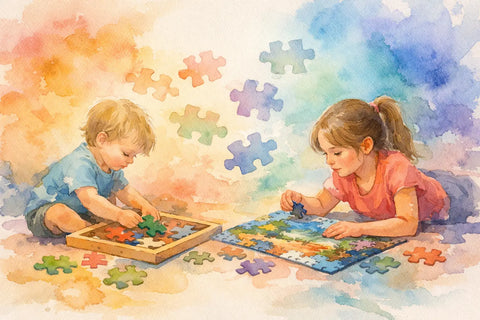
A toddler proudly pressing one chunky piece into place is not just passing time. They are practising grip strength, visual matching, patience and the satisfying idea that small efforts can make a complete picture. So, when should kids start puzzles? For most children, simple puzzles can begin around 12 to 18 months, provided the pieces are large, sturdy and designed for their age.
The right starting point is less about hitting an exact birthday and more about matching the puzzle to a child’s hands, attention span and confidence. A puzzle that is too tricky quickly becomes frustrating. One that is just right creates those magic, repeatable moments of “I did it!”
When Should Kids Start Puzzles by Age?
Around 12 to 18 months: chunky first puzzles
At this stage, children are learning through touch, repetition and cause-and-effect. Large knob puzzles, inset shape puzzles and simple boards with one to three pieces are ideal. Look for familiar images such as animals, vehicles, fruit or everyday objects, with clear outlines that make the matching task easy to understand.
Adult supervision matters here. Pieces need to be larger than a child could put in their mouth, with smooth edges and materials built to handle enthusiastic little hands. The goal is not independent completion. It is letting children explore, turn pieces over, test where they fit and enjoy your encouragement.
A durable plastic puzzle can be particularly practical for this age. It is easier to wipe clean after snack time or an afternoon on the deck, and it stands up better to repeated use than a flimsy alternative.
Around 18 months to 2 years: matching begins to click
Many children can move on to four- to six-piece inset puzzles, basic peg puzzles or very simple jigsaws with chunky pieces. They may still need help rotating a piece or spotting which way it faces, but their matching skills are becoming more deliberate.
Choose pictures with strong colour contrast and obvious subjects. A busy illustration can be lovely, but it asks a lot of a young child who is still learning to separate one visual detail from another. Clear, cheerful artwork gives them useful clues without doing the job for them.
Keep sessions short. Five engaged minutes can be far more valuable than twenty minutes of persuasion. Put the puzzle away while it still feels fun, then bring it back another day.
Ages 2 to 3: small jigsaws and growing independence
Between two and three, many children are ready for simple jigsaw puzzles with roughly six to 12 pieces. Their fine motor control is improving, and they begin to understand that pieces join together to create one larger scene.
This is a great age to build a gentle routine. Set a puzzle out on the coffee table before breakfast, or make one part of a quiet afternoon activity. Rather than immediately pointing to the answer, try prompts such as, “Can you find the blue piece?” or “Where might the cat’s ears go?” It keeps the child in charge while offering enough support to prevent a stall.
Some children will race ahead; others will happily repeat the same six-piece puzzle for weeks. Both are normal. Repetition is how young children learn patterns and gain confidence.
Ages 3 to 4: 12 to 24 pieces with a real challenge
Preschoolers often enjoy puzzles in the 12- to 24-piece range, especially when the image reflects a current obsession: dinosaurs, space, ocean creatures, construction vehicles or fairy-tale scenes. They can usually sort edge pieces, notice colour groups and persist through a little trial and error.
This is also the age where a puzzle becomes a shared activity rather than simply a toy. Sitting alongside a child and working on different sections creates conversation without the pressure of face-to-face questioning. You may hear more about their day while looking for a purple flower or a piece of a rocket.
For families who value products that last, water-resistant plastic puzzles have a useful advantage. Pieces interlock firmly, are less likely to bend or tear, and can be enjoyed repeatedly by younger siblings. That makes a favourite design feel more like a keepsake than a one-season activity.
Ages 4 to 6: 24 to 60 pieces and picture-building skills
By school-entry age, many children are ready for puzzles with 24, 36, 48 or 60 pieces. They can use the box image as a reference, work from corners and edges, and recognise that similar colours or patterns belong in the same area.
The piece count is only one guide. A 48-piece puzzle with large, clearly defined animals may be easier than a 24-piece puzzle filled with similar green leaves or a dark night sky. Image complexity, piece size and how strongly the pieces connect all affect the experience.
At this stage, offer a puzzle that requires effort but still lets the child finish with minimal rescue. If they abandon it more than once, go down a level or choose a clearer image. If they complete it in minutes and immediately ask for another, it may be time to step up.
How to Choose the Right Kids’ Puzzle
Age labels are useful safety and difficulty guides, but they are not a test of ability. A child who has spent lots of time with puzzles may be ready for more pieces earlier. Another may have brilliant storytelling skills but little interest in sitting still with small pieces. Follow the child in front of you.
When choosing a puzzle, consider four practical factors:
- Piece size and safety: Younger children need larger pieces and close supervision. Always follow the manufacturer’s recommended age, particularly where small parts are involved.
- Image clarity: Distinct colours, recognisable characters and defined sections give beginners a fair chance of success.
- Material quality: Thick, durable pieces are easier for little fingers to pick up and more likely to survive regular play.
- The finish: Children love seeing a completed picture. A puzzle that stays securely together can be moved, admired and even displayed in a bedroom or play space.
Signs Your Child Is Ready to Move Up
Look for behaviour rather than a number on the box. Your child may be ready for a harder puzzle when they finish their current one without much help, start sorting pieces by colour or shape, or remain interested after the obvious sections are complete.
They may also begin asking for “a bigger one” or choosing puzzles during free play. That enthusiasm is worth following, but bigger is not always better. Moving from 12 to 100 pieces in one jump can turn a favourite hobby into a chore. A gradual increase keeps the sense of achievement intact.
If a child is becoming frustrated, step in thoughtfully. Turning a piece so it is facing the right direction, finding two edge pieces together, or suggesting a colour group is helpful. Completing half the puzzle for them usually is not. The real reward comes from their own discovery.
Puzzles Are More Than Quiet-Time Entertainment
Puzzles support a surprisingly broad set of early skills. Children practise hand-eye coordination as they pick up and place pieces, spatial awareness as they rotate them, and problem-solving as they test different options. They also build emotional skills: waiting, trying again and coping with a piece that almost fits but does not.
They are equally valuable as a low-screen family activity. A puzzle on the dining table invites children to return throughout the day, while a completed design gives everyone a visible result to enjoy. For gift buyers, that combination of play, learning and display value makes a quality kids’ puzzle an easy choice for birthdays, Christmas or a rainy-weekend surprise.
Puzzle Art Store’s kids’ puzzle range is designed for that kind of repeat enjoyment: colourful designs, durable plastic construction, water resistance and pieces that click together securely. No glue needed when a young puzzler decides their masterpiece deserves a spot on the wall.
Start small, keep it enjoyable and let each completed picture build the appetite for the next one. The best first puzzle is not the one with the most pieces - it is the one your child cannot wait to make again.

Comments (0)
There are no comments for this article. Be the first one to leave a message!