
A finished puzzle should not have to disappear back into its box the moment the last piece clicks in. Display puzzles for beginners offer a more satisfying finish: a creative activity for the table, followed by artwork, a conversation piece or even a functional décor item for the home. The key is choosing a puzzle designed to stay together and look good once complete.
For first-time display puzzlers, the best choice is rarely the biggest piece count or the most complicated image. Start with a design you genuinely want to see every day, a manageable build time and pieces that lock firmly into place. That turns the final reveal into something worth showcasing rather than a project you feel obliged to preserve.
Display Puzzles for Beginners: Start with the Right Style
Your first display puzzle should suit both your puzzling confidence and your space. A beautiful 500-piece design can be more rewarding than forcing your way through 1,000 tiny pieces, especially if you are still learning how you like to sort, build and work through tricky sections. Look for clear colour areas, recognisable shapes and an image with enough contrast to guide you along.
Think about where the completed puzzle will live before you begin. A bright floral artwork may lift a hallway, kitchen or home office. A calm landscape can work beautifully in a bedroom, while a bold art print makes a strong feature on a living room wall. Choosing with the room in the mind makes the finished result feel intentional, not like an afterthought.
For a smaller commitment, compact puzzles, puzzle cards and magnets are excellent confidence-builders. They deliver the satisfying click of completion without taking over the dining table for a week. They also make thoughtful gifts for someone who enjoys hands-on activities but is not ready for a large-format project.
Flat art or functional 3D décor?
A flat 2D puzzle is the easiest entry point if you want a framed artwork look. It gives you a familiar jigsaw experience, with a display result that can suit almost any interior style. Choose this format when the image is the main attraction.
3D puzzles add another layer of novelty. Puzzle vases, planters, clocks and globes can become useful objects as well as decorative ones. They are a wonderful option for gift buyers because the recipient gets both an activity and a finished piece with a purpose. The trade-off is that curved or structural builds require a little more patience, so follow the instructions closely and allow yourself time to understand the shape as it develops.
Why Material Matters When You Want to Display It
Traditional cardboard puzzles can be lovely to assemble, but displaying them often means dealing with glue, lifting a delicate finished surface and finding a frame that fits. If the puzzle bends, separates or gets splashed, all that work can be at risk.
Premium plastic puzzles are built for a different kind of finish. Their precision-cut interlocking pieces are designed to hold together firmly, which means no glue needed for many display setups. That is a major advantage for beginners: you can move the completed puzzle more confidently, try it in a frame or display stand, and change your mind later without committing to a permanent adhesive layer.
Water-resistant material is another practical win for real homes. It does not mean a completed puzzle should live in the shower or be treated carelessly, but it offers peace of mind around everyday spills, damp hands and busy family spaces. For a household with children, pets or a lively kitchen bench, durability makes the hobby far less precious.
This is where a display-ready puzzle earns its place. You are not simply buying an evening of entertainment. You are creating a reusable, collectible décor piece that can keep bringing colour and personality to a room.
Set Up Your First Build for an Easier Finish
A good start removes much of the frustration beginners associate with puzzles. Pick a flat, well-lit surface where the puzzle can stay undisturbed. A dining table works well, but a puzzle board is handy if you need to reclaim the table between meals. Keep drinks to one side and give yourself enough room to spread out the pieces without stacking them into one giant pile.
Begin by turning every piece face-up and separating the edge pieces. Build the border first if that feels natural, then sort the remaining pieces into broad colour or pattern groups. You do not need dozens of neat little containers. Two or three trays, shallow boxes or even clean plates will do the job.
When progress slows, resist the urge to try every piece in every gap. Study the image and choose one area with a distinctive feature: a flower centre, a window, a bright bird, a face or a clearly defined block of colour. Completing small sections gives you visual anchors and keeps the build enjoyable.
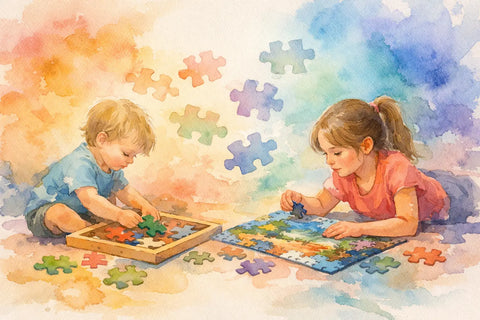
If you are puzzling with family, divide the work by image area rather than by speed. One person can tackle the sky while another works on the foreground, then join the sections together. It is more relaxed, and everyone gets a proper moment of achievement when their section clicks into place.
How to Turn Your Finished Puzzle into Décor
Once the final piece is in, take a moment to enjoy it before moving anything. Check that all pieces are fully seated and gently press across the surface with clean hands. With a tightly interlocking plastic puzzle, this simple check helps make the whole piece feel secure.
For wall display, measure the completed puzzle rather than relying only on the box dimensions. A frame with a clean, simple border lets the artwork stand out, while a deeper frame can create a more gallery-like finish. If you prefer a casual look, a display ledge or easel can make the puzzle easy to swap out with the seasons.
Consider the light in the room. Glossy surfaces and glass frames can reflect harsh sunlight, so position the artwork where its colours can be seen without constant glare. Direct sun can also be tough on many decorative items over time, making a shaded wall a smart choice.
For 3D pieces, display them where their shape can be appreciated from more than one angle. A puzzle vase looks best with a little breathing room on a sideboard or shelf. A clock needs a spot where it can actually be read. A globe can become a playful desk feature for a study, child’s room or home office.
Choose a Puzzle You Will Still Love After Completion
The most common beginner mistake is picking an image purely because it looks difficult or impressive. Display value matters more. Ask yourself whether the finished design suits your colour palette, tells a story you enjoy or makes you smile when you walk past it.
Collectible art designs are ideal if you like refreshing your walls or rotating décor through the year. Build a fresh piece for a birthday, Christmas or a new-home gift, then keep the completed work as part of the present. It is personal without requiring you to make something from scratch.
For children, choose age-appropriate piece counts and engaging artwork rather than pushing too far too soon. Junior puzzles can strengthen concentration, visual matching and patience, while giving young puzzlers a finished picture they are proud to show off. A display spot in their room can make that achievement feel even bigger.
Puzzle Art Store specialises in premium, display-ready puzzle formats that make this transition from pastime to décor refreshingly straightforward. Whether you prefer a framed 2D artwork or a clever 3D object, the best first project is one that feels achievable, looks fantastic and deserves a place in your home.
Start small if you need to, choose a picture with staying power, and let the final click be the beginning of your décor story rather than the end of the fun.
Comments (0)
There are no comments for this article. Be the first one to leave a message!