
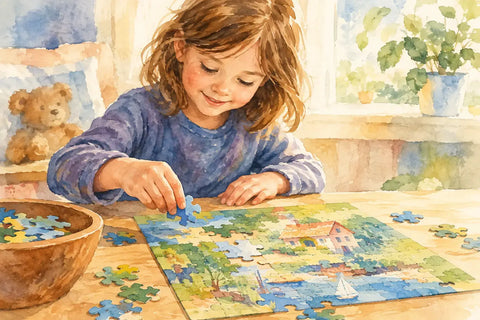
A child turning a puzzle piece three different ways before it finally clicks is doing far more than passing time. The best kids puzzle learning examples show how hands-on play can build patience, visual awareness, language and the confidence to keep trying when an answer is not immediate.
For families, the appeal is wonderfully practical. A puzzle can bring calm focus to a rainy afternoon, create an easy shared activity after school, and leave children with something they are proud to display. When the pieces are durable, water resistant and designed to stay together without glue, that finished picture can become part of their room rather than another temporary craft headed for the rubbish.
Why puzzles teach through play
Puzzles invite children to notice, test and adjust. They are not simply matching activities. A child looks for a familiar colour, compares the shape of a tab with a gap, rotates a piece in their fingers, then decides whether to try again. That repeat-and-rethink process is the heart of early problem-solving.
They also make learning tangible. Counting pieces gives numbers a purpose. Sorting edge pieces introduces categories. Talking about a picture builds vocabulary, while assembling a scene in order can support storytelling and memory. The learning is strongest when adults stay alongside the child without taking over. A small prompt such as, “What colour do you notice near the corner?” is often more useful than pointing to the exact piece.
Kids puzzle learning examples by skill
Fine motor control and hand strength
For younger children, large-piece jigsaws are a brilliant place to begin. Picking up, turning and pressing each piece into place helps develop the small hand movements used later for drawing, buttons, scissors and pencil control. Choose images with clear colour blocks, recognisable animals or familiar vehicles so the child has visual clues as well as piece shapes.
A simple example is a child sorting all the blue sky pieces before attempting the rest of the image. They practise grip and coordination while learning that a big task becomes easier when it is organised into smaller parts. Plastic pieces can be particularly reassuring for everyday family play because they are sturdy and can handle the occasional spill or sticky finger.
Visual matching and spatial awareness
As children grow, puzzles become a quiet lesson in position and perspective. They learn that a piece with part of a wheel belongs near other road details, or that a curved line may be the edge of a globe rather than a random shape. They also discover that a piece may be correct even when it is upside down at first glance.
Try placing a small number of pieces face-up and asking your child to find two that share a colour, pattern or object. Then ask what they think the completed picture might show. This turns a standard puzzle session into a gentle observation game, without making it feel like homework.
Early maths and sorting
Puzzles provide natural ways to use mathematical thinking. Children can count the pieces in a tray, group them by colour, identify the straight-edged border pieces and compare which section has more or fewer pieces left. A 3D puzzle adds another layer, because the child must consider height, curves and how one section supports another.
A vase, planter or globe-style puzzle can be especially engaging for children who enjoy building rather than sitting with a flat image. The finished object also gives the activity a satisfying purpose. They have not only completed a puzzle - they have made something useful or display-ready.
Language, storytelling and general knowledge
Picture puzzles are excellent conversation starters. An ocean scene might prompt words such as reef, shell, boat and wave. A wildlife illustration can lead to a chat about habitats, while a city scene encourages children to describe what people might be doing. There is no need for a quiz. Follow their observations and add one or two new words naturally.
For a storytelling challenge, begin with one completed area of the puzzle and ask, “What happened just before this moment?” or “Where do you think this character is going?” Children practise sequencing, imagination and verbal expression while their hands remain busy.
Persistence, emotional regulation and confidence
Not every learning benefit is academic. Puzzles teach children that being stuck is normal. A tricky section asks for a pause, a new strategy or a little help. Completing it after several attempts creates a real sense of achievement because the result is visible.
The key is matching the difficulty to the child. Too few pieces can feel uninteresting; too many similar colours can become frustrating. A puzzle should contain a few satisfying challenges, not feel impossible from the first handful of pieces. If a child walks away, leave the puzzle safely set up and return later. Fresh eyes often find the next match quickly.
Choosing the right kids puzzle challenge
Age guidance is a useful starting point, but it is not the whole story. A child who loves dinosaurs may stay focused on a more complex dinosaur picture than on a simpler image they do not care about. Equally, a child with plenty of puzzle experience may be ready for a higher piece count, while another child will enjoy a larger format for longer.
Consider piece size, image detail and how much independent play you want. Large, distinct pieces and bold artwork suit beginners. More pieces, finer details and repeated colours offer a greater challenge for confident puzzlers. For family sessions, choose a design with several recognisable sections so everyone can claim an area - the sky, a bright building, a group of animals or the border.
Material matters too. A quality plastic puzzle feels different from a thin cardboard puzzle that bends easily or separates when moved. Interlocking pieces that hold together can make it easier for children to lift their finished work, show it to grandparents or move it into a frame. No glue needed means the display step remains simple, and water resistance is a welcome benefit in busy family homes.
Make puzzle time more rewarding
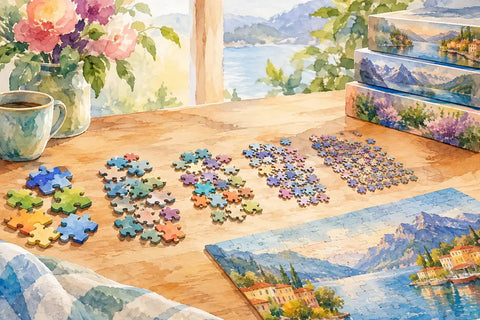
Set up the activity on a clear table or tray where pieces will not disappear under furniture. Start by turning pieces picture-side up together, then decide whether to make the border first or build the most exciting part of the picture. There is no single correct method. Some children love order; others want to find the dragon, rainbow or racing car first.
Keep adult help light and specific. Instead of saying, “That goes there,” try, “This piece has a straight side. Where might straight sides belong?” This gives children a clue while preserving their ownership of the solution. If siblings are working together, give each child a zone or job so the quicker puzzler does not quietly complete the whole thing.
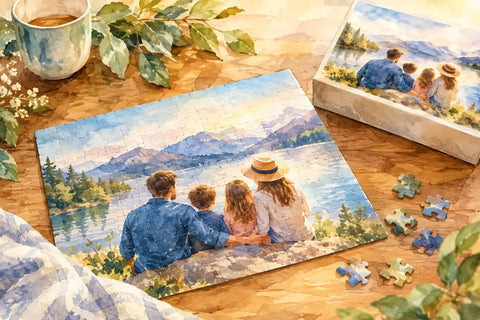
When the puzzle is done, make a moment of it. Take a photo, talk about the trickiest section, or choose a place to display it. At Puzzle Art Store, durable, display-ready kids’ puzzles make that final step feel special: a finished design can move from tabletop achievement to colourful room décor.
When a puzzle is too easy or too hard
Children often signal the right level through their behaviour. If they complete a puzzle without looking closely, introduce more pieces or an image with finer detail. If they are repeatedly forcing pieces, becoming upset or losing interest after only a few minutes, reduce the piece count or choose clearer artwork.
There is also value in revisiting a puzzle. The second and third build are not wasted play. Familiarity lets children practise speed, strategy and recall, and it can turn a previously challenging puzzle into a confidence builder. Rotate a small collection rather than putting every puzzle out at once, so a favourite returns feeling fresh.
A well-chosen puzzle gives children a calm place to practise thinking with their hands. Let them choose a picture they genuinely love, offer just enough support, and celebrate the moment each small piece becomes part of something complete.
Comments (0)
There are no comments for this article. Be the first one to leave a message!